When people talk about AI in projects, one of the questions I hear most often is:
“Where can we use AI?”
It is an understandable question.
But it is often the wrong starting point.
Because it risks turning technology into a solution in search of a problem.
A project should not adopt AI simply because it is available.
It should adopt it when there is a concrete reason to do so.
And that reason can come from two different directions.
From a problem we want to solve.
Or from a possibility that was not realistically available before.
The interesting part is distinguishing between the two.
Two different ways to arrive at a use case
The first approach is the more intuitive one.
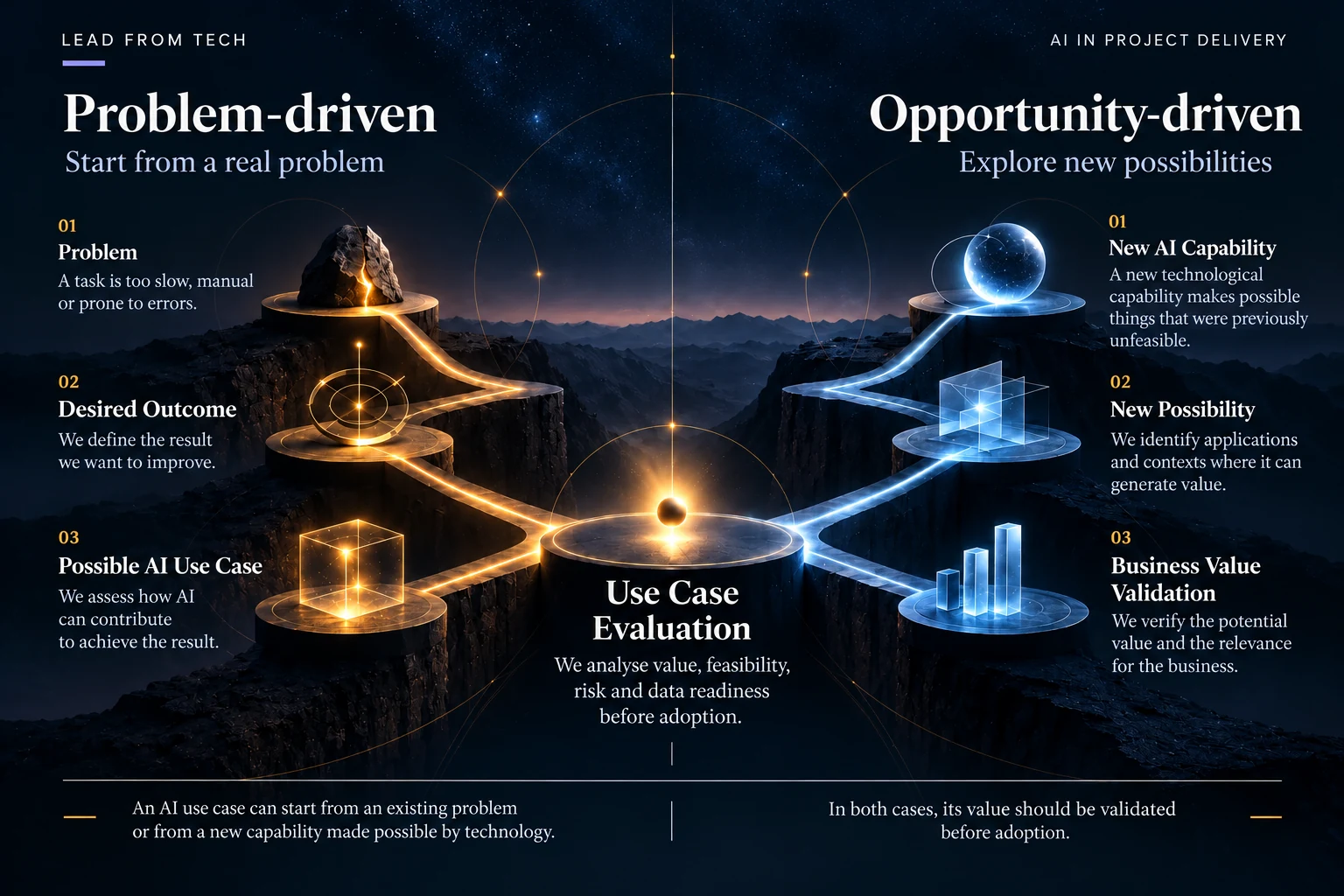
Problem-driven
A problem already exists.
For example:
- response times that are too long;
- repetitive manual processes;
- frequent errors;
- large volumes of documentation to analyse;
- information spread across too many sources;
- decisions that take too long;
- activities with a high cognitive load.
In this case, the sequence is:
Problem → Desired Outcome → Possible AI Use Case
Technology comes later.
The first question is:
“What outcome do we want to improve?”
This prevents us from confusing technical capability with value.
But there is also a second path.
Opportunity-driven
AI makes possible things that were previously:
- too expensive;
- too slow;
- too complex;
- or simply impractical.
In this case, we are not necessarily solving an already defined problem.
We are discovering a new possibility.
The sequence becomes:
New AI Capability → New Possibility → Business Value Validation
It is a different approach.
And it should not be ruled out.
Because AI is not only useful for doing better what we already do.
It can also change what we consider possible.
An example: improving oversight of an IT programme
Imagine a programme made up of several projects, each with its own manager, plan, risks, and progress updates to consolidate.
The problem might be the amount of time needed to reconstruct the programme’s overall status.
A problem-driven approach would start from this inefficiency, analysing the information sources and assessing whether AI could help summarise updates, identify inconsistencies, or highlight critical issues.
An opportunity-driven approach, on the other hand, might begin with a new technological capability: jointly analysing structured information and project documentation, enabling forms of decision support that were previously too costly.
The two paths may lead to similar solutions, but they originate from different assumptions.
And neither one, by itself, proves that AI is the right choice.
If the problem is simply caused by outdated data or unclear responsibilities, introducing a model could add complexity without addressing the root cause.
The point is not to choose between the two approaches
Problem-driven and opportunity-driven are not alternatives.
They are two entry points.
The problem arises when we confuse:
possibility
with
priority.
The fact that AI can do something does not mean it is worth doing.
Likewise, the fact that a problem exists does not mean AI is necessarily the best solution.
This is where a filter is needed.
Four questions before calling it an “AI use case”
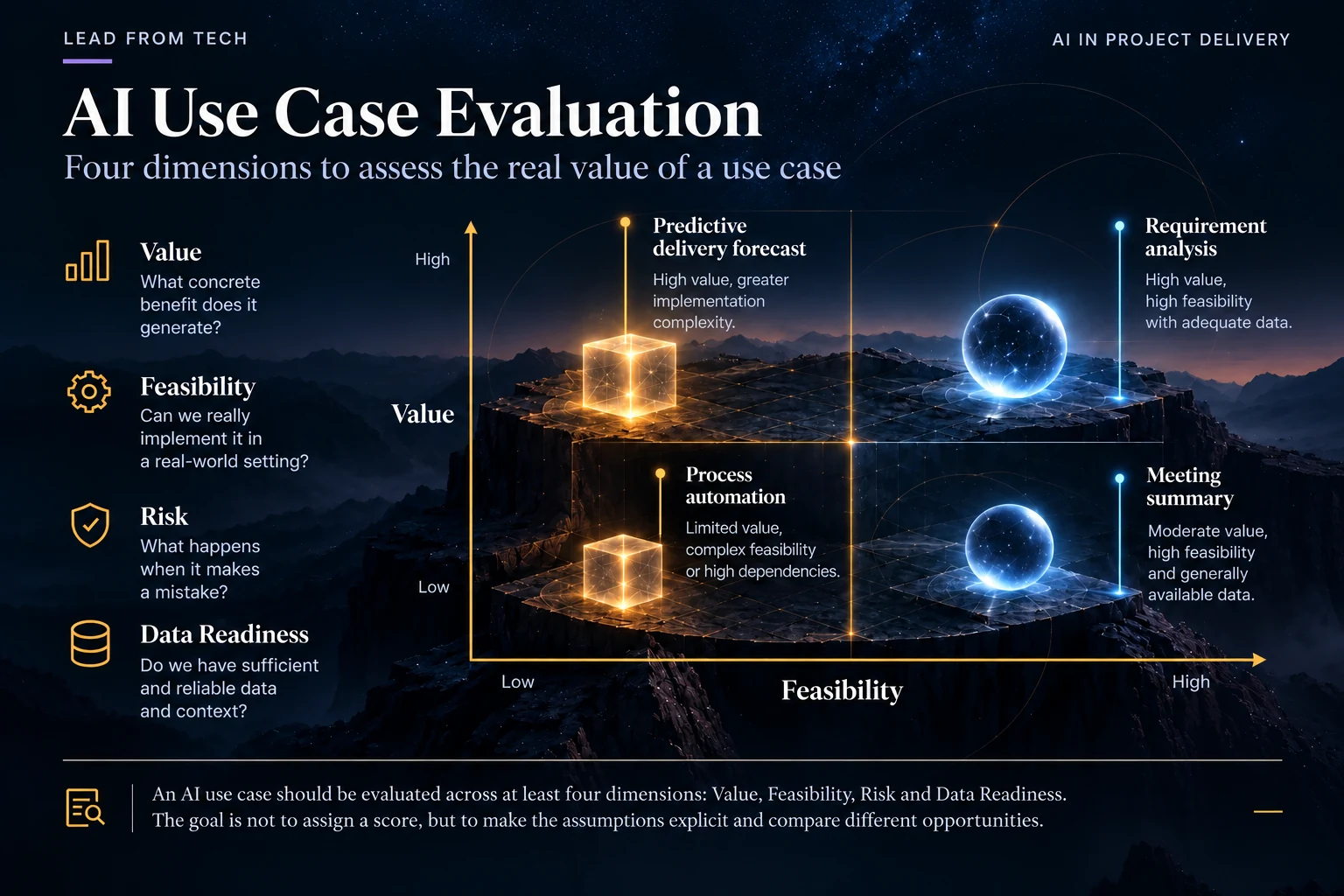
When evaluating a use case, I find it useful to consider at least four dimensions:
1. Value
What concrete benefit does it generate?
Can we connect it to something observable?
For example:
- reduced cycle time;
- fewer errors;
- increased throughput;
- reduced operational workload;
- improved quality;
- reduced decision latency;
- a better experience for users or operators.
If we cannot describe the expected value, the use case is probably not mature enough yet.
2. Feasibility
Can we actually implement it?
Not in a demo.
In a real-world setting.
This means considering:
- existing systems;
- integrations;
- available skills;
- costs;
- timelines;
- scalability;
- infrastructure constraints;
- technological dependencies.
Many use cases appear simple until they have to fit into existing processes and systems.
3. Risk
What happens when it gets something wrong?
This is one of the most important questions.
Not all errors carry the same weight.
An error in an internal summary can be corrected easily.
An error in an automated decision can have much more serious consequences.
Risk varies according to:
- impact;
- reversibility;
- data sensitivity;
- accountability;
- error frequency;
- capacity for human verification.
The higher the risk, the stronger the controls need to be.
4. Data Readiness
Do we really have enough data and context?
A powerful model does not automatically fix:
- incomplete data;
- inconsistent sources;
- outdated information;
- non-standardised processes;
- unclear ownership.
A use case may offer enormous value and high technical feasibility, yet still fail because the organisation does not have an adequate information foundation.
The four dimensions are not an automatic decision-making formula.
They help make assumptions explicit and compare different opportunities.
A use case with high potential value might first require investment in data quality. Another, less ambitious but easier to integrate, might represent a more sensible initial experiment.
The goal is not to assign an arbitrary score to every idea.
It is to make clear why an organisation decides to invest in one opportunity rather than another.
A working demo is not yet a project
This is probably one of the most common mistakes.
A proof of concept can demonstrate that:
the technology is capable of doing something.
But a project has to demonstrate much more.
It has to demonstrate that:
- the result is reliable enough;
- the process can absorb it;
- users will adopt it;
- the cost is sustainable;
- the risk is acceptable;
- ownership exists;
- KPIs exist;
- its behaviour can be governed.
The gap between:
“it works in a demo”
and
“it creates value in production”
can be enormous.
AI can be useful even when it is not part of the final solution
There is another distinction that I consider particularly important.
Using AI during the design process does not necessarily mean building a solution that uses AI in production.
It can be used to:
- explore alternatives;
- analyse requirements;
- summarise documentation;
- simulate scenarios;
- generate prototypes;
- compare options;
- highlight risks;
- accelerate discovery and design.
The final outcome might be:
- a different process;
- an organisational simplification;
- a new interface;
- deterministic automation;
- an architectural change.
With no AI model in the final solution.
This distinction matters because it separates:
AI as design capability
from
AI as production component.
And the two are not the same.
Sometimes the right choice is not to use AI
This is probably the hardest decision to make at a time of intense pressure to adopt AI.
But some problems already have solutions that are:
- less expensive;
- more reliable;
- easier to understand;
- easier to govern.
If a deterministic rule solves the problem well, there is no need to replace it with a probabilistic model.
If the bottleneck is organisational, AI may not be the priority.
If the data is insufficient, perhaps the first investment should be in the data foundations.
If the process is inconsistent, accelerating it may simply produce inconsistency faster.
Choosing not to use AI can be a technologically mature decision.
A strong use case does not mean the project is ready
There is also a second level.
We may have:
- high value;
- good feasibility;
- manageable risk;
- apparently adequate data.
And still not be ready.
Because the project or the organisation may not yet have:
- clear ownership;
- policies;
- skills;
- escalation procedures;
- validation processes;
- monitoring;
- defined responsibilities.
Therefore:
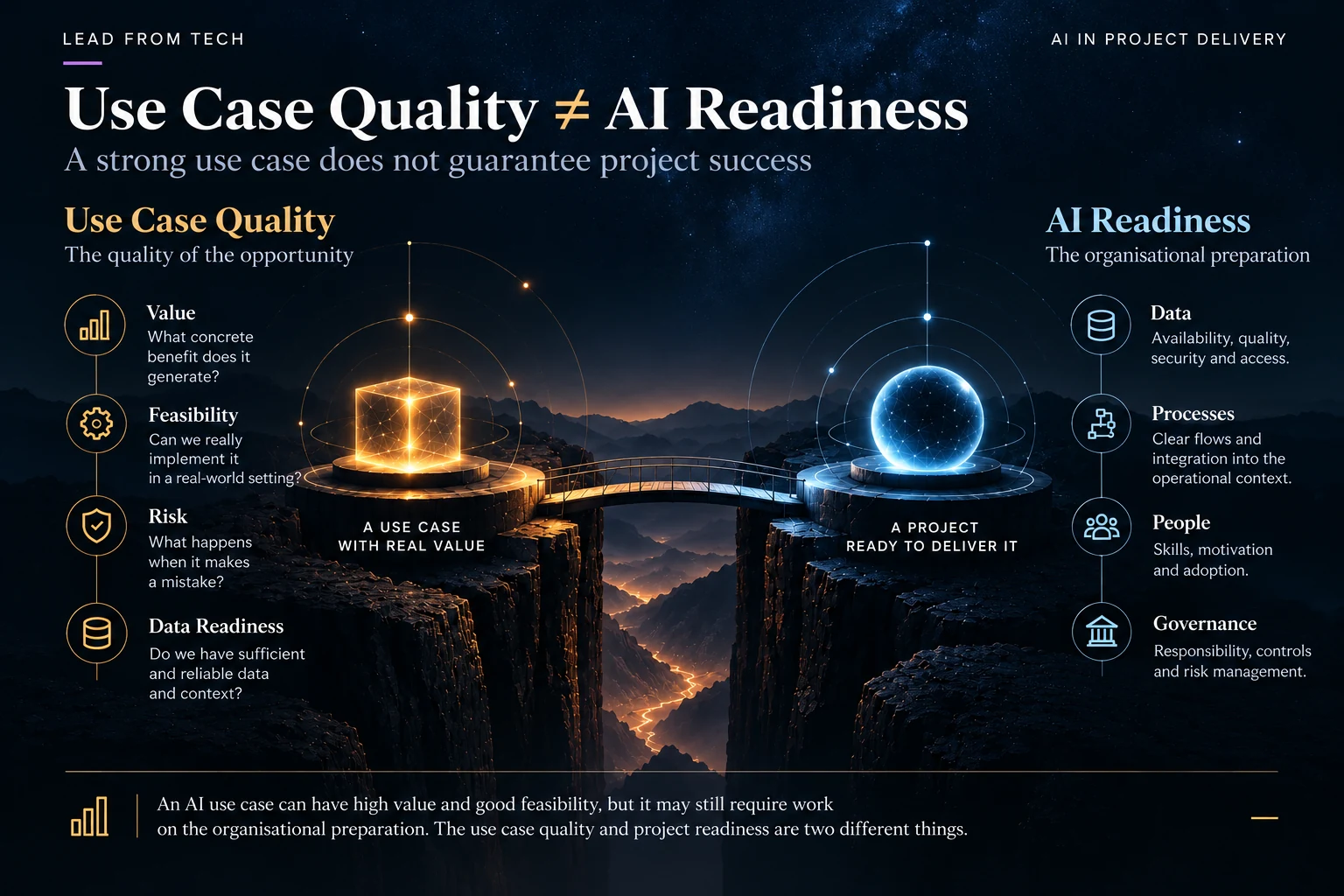
Use Case Quality ≠ AI Readiness
These are two different assessments.
The first answers:
“Is it worth doing?”
The second:
“Are we in a position to do it well?”
The real question changes
At this point, the initial question:
“Where can we use AI?”
becomes something more useful:
“Where can AI generate enough value to justify complexity, risk, and change?”
It is a less exciting question.
But a much more useful one.
Above all, it shifts the conversation from technology to decision-making.
From project to governance
The more I explore these topics, the more interesting I find it that the most important decisions about AI are often not primarily technological.
They concern priorities, responsibilities, processes, data, risk, adoption, and measurement.
These are aspects I am also exploring through the CPMAI programme, but I encounter them above all in the day-to-day practice of managing IT projects and programmes.
Because the point is not only to understand what AI is capable of doing.
It is to decide what is worth doing, under what conditions, and with what responsibilities.
Good AI governance begins before selecting a model.
It begins when we are able to distinguish a technological opportunity from a business priority.
And when we are willing to recognise that, in some cases, the best decision is not to use AI.
This is the starting point for a new series of Insights on Lead From Tech.
In the next Insight, we will address an equally important distinction:
Can a project have an excellent AI use case and still not be ready to deliver it?
Very often, the answer is yes.
And this is where AI Readiness comes into play.